Friday, May 4, 2018

History of Egypt, Chaldea, Syria, Babylonia, and Assyria Volume I


Gaston Maspero
The Grolier Society
London, UK
1904
Volume 1

I have had this series of 114-year-old books for many years, but never read them. The author Gaston Maspero was the head of Egypt's Egyptian Museum and in charge of giving excavation permits in the late 19th century and early 20th century. Mr. Maspero was the chief Egyptologist and expert archaeologist of Oriental history. It must be noted that the use of and spelling of English words from 1904 differ from today's vocabulary. It must further be noted that interpretations of Egyptian hieroglyphs, particularly names, have also changed over the past century.

The book opens with a layout of the course the opening chapter will follow in an overview of the geography of the Nile valley and the course of history that man has existed within these environs, and how the early Egyptians used their environment to advantage. Early farmers learned to make use of mud-built canals and dikes to water fields during the inundation season when the Nile floods its banks. The advent of stone tools created devices for hunting, fishing, spinning cloth, and the production of pottery, of which upper Egyptian potters created very fine vessels. The reader is presented with the Nile god Hapi, who resided in a grotto on the island of Biggeh.

"Hail to thee, Hapi! - who appearest in the land and comest - to give life to Egypt; - thou who dost hide thy coming in darkness - in this very day whereon thy coming is sung, - wave, which spreadest over the orchards created by Ra - to give life to all them that are athirst - who refusest to give drink unto the desert - of the overflow of the waters of heaven".1

Mr. Maspero lays down the basic food crops of vegetables, grains, and fruit like figs to make various kinds of bread and beer, and the domestication of various animals. The chapter ends with the various nomes, their main towns, and the nomarchs who ruled them. These nomes have a given god whom the local population worships. The book is filled with drawings of 19th-century photographs and various works of art on most pages.

                                                             The Guardians of the Temple

The author gives an overview of the many gods and goddesses that were worshiped in ancient Egypt. These gods are local deities attached to local fetishes or standards. There are also national gods as Hapi, the Nile god, or in later times, the rise of the God Amun. Invasion and conquering other nomes would result in the cannibalization of the losing tribe's deity, whose powers would be absorbed by the victorious nomes' god.

"It was the duty of certain genii to open gates in Hades or to keep the paths daily traversed by the sun. These genii were always at their posts, never free to leave them, and possessed no other faculty than that of punctuality fulfilling their appointed offices. Their existence, generally unperceived, was suddenly revealed at the very moment when the specific acts of their lives were on the point of accomplishment. These being completed, the divinities fell back into their state of inertia, and were, so to speak, reabsorbed by their functions until the next occasion. Scarcely visible even by glimpses." 2

Mr. Maspero moves on to the constellations.

"A world as vast as ours rested upon the other side of the iron firmament; like ours, it was distributed into seas, and continents divided by rivers and canals, but peopled by races unknown to men. Sahu traversed it during the day, surrounded by genii who presided over the lamps forming his constellation. At his appearing ' the stars prepared themselves for battle, the heavenly archers rushed forward, the bones of the gods upon the horizon trembled at the sight of him,' for it was no common game that he hunted, but the very gods themselves. One attendant secured the prey with a lasso, as bulls are caught in the pastures, while another examined each capture to decide if it were pure and good for food. This being determined, others bound the divine victim, cut its throat, disembowelled it, cut up its carcass, cast the joints into a pot, and superintended their cooking."3

The reader is presented with the art and reasons for mummification by the ancient Egyptians. The development from the earliest times in the predynastic mummies naturally dried in their desert graves, and the defleshed, disarticulated skeletons left from early attempts.

The author moves on to the relationships of the deities to each other, including triads of a mother, father, and son, though not all gods belong to such groupings. The various traditions of the Enneads are laid out in the earliest dynasties of Egypt and her god-kings.

     "Scarcely was Sibu enthroned as the successor of Shu, who, tired of reigning, had reascended into heaven in a nine days' tempest, before he began his inspection of the eastern marches, and caused the box in which was kept the uraeus of Ra to be opened. "As soon as the living viper had breathed its breath against the Majesty of Sibu there was a great disaster- great indeed, for those who were in the train of the god perished, and his Majesty himself was burned in that day."4

Mr. Maspero introduces the advent of the rule of mortal kings beginning with King Menes and the rulers of Dynasty 1, whose graves are at Abydos and were first excavated by Emile Amelineau between 1895 to 1899. Flinders Petrie's re-excavation of the same site was caused by the unprofessional and unpublished excavations and wild theories put forward by the excavator Amelineau, now discredited for being little more than a plunderer today.

The book ends with an examination of the early Archaic rulers and their monuments, to that of King Zosiri (Djoser), including the content of the" Famine Stela" and the step pyramid, which the author argues forward the green glazed tiles in that pyramid's apartments are not of the Third Dynasty but of Dynasty XXVI.

The book was a difficult read with the changes in the interpretations of the hieroglyphs and the outdated English in which the book is written. The book is definitely not for children and those looking for a romantic read, but for those college-age students of Egyptology, it is a must-read. Everyone else should probably pass on this book.

Notes:

1. page 51
2. pages 109-110
3. page 130
4. page 243

Thursday, May 3, 2018

Pyramid of Amenemhet I Yields More Reliefs

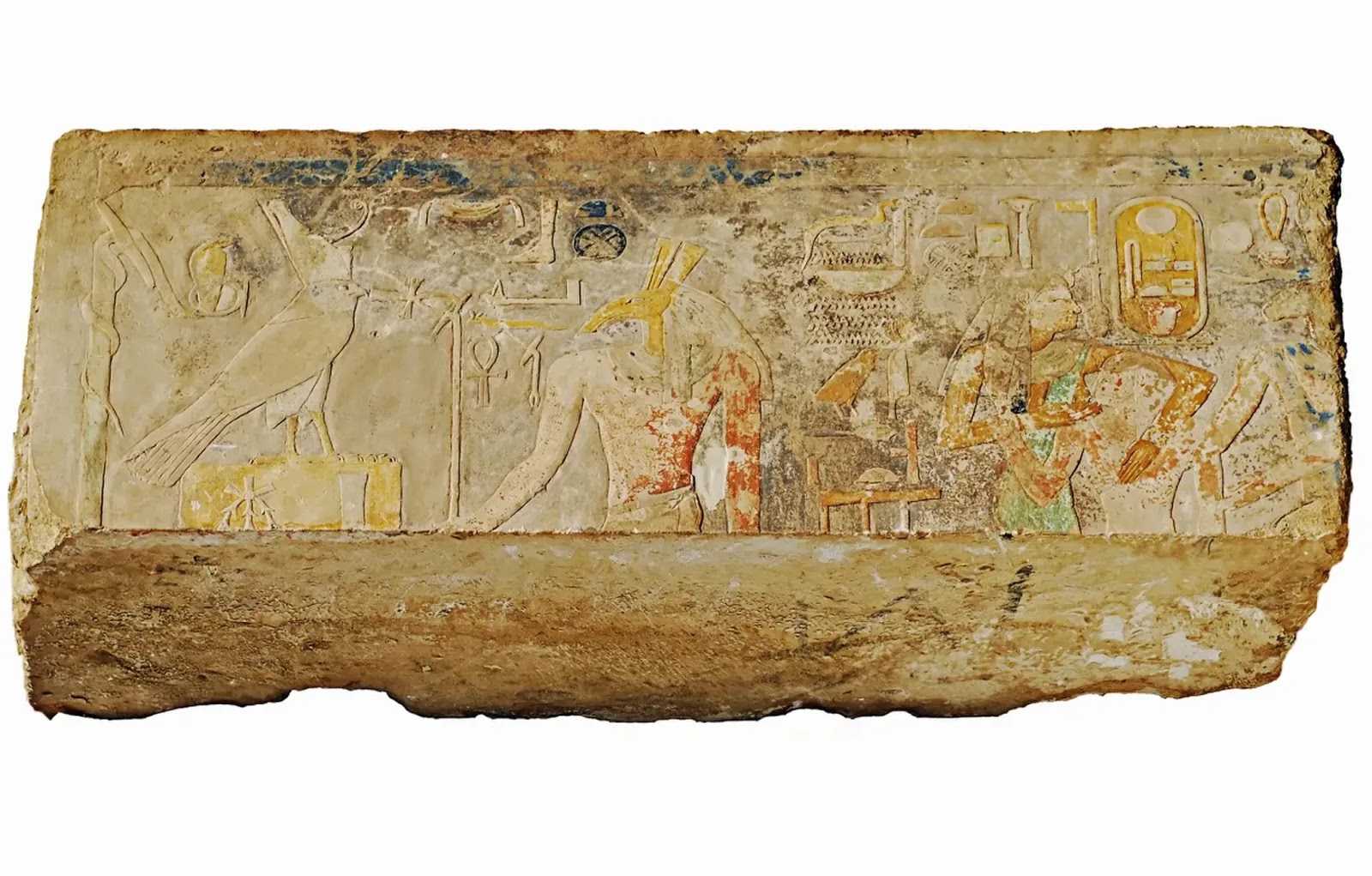
This article is about the rescue of two limestone blocks for the antiquities authority, which were discovered at Amenemhet I's pyramid in 2011. The blocks had been found by looters, one of whom called the proper authority, hoping for a reward.  The result was an affair of some cunning, including the skill of transporting two giant blocks of enormous weight and avoiding looters.

The first lovely block above is part of the decoration for Amenemhet's funerary monument, while the second appears to be an older block reused in the monument. The pyramid has produced many Old Kingdom carved reliefs from funerary monuments of Khufu, Khafra, and Unas, among others, and was used as fill within the construction. These blocks may have been used for magical associations between Amenemhet and his predecessors and or suggest that the monuments of the Old Kingdom were in ruin by that time. Amenemhet I founded the 12th dynasty ca. 1991 - 1962 B.C., and appears to have been assassinated according to a papyrus known as the Instructions of Amenemhet, where the king's ghost speaks to his son and heir Senwosret I.

Notes:
1. Live Science
2. Tour Egypt
3. Instructions of Amenemhet I

Friday, April 27, 2018

The Unrolling of the Mummy of Nebset


I recently had the privilege of coming across a rare book, Transactions of the Society of Biblical Archaeology, 1877, which contained a piece of mummy cloth from the unrolling of the mummy of Nebset on July 15, 1875. The mummy from ancient Egypt's 22nd dynasty was reported to have been found at Sheikh Abd el-Qurna and acquired by the British Consul-General in Egypt, General Stanton, and gifted to the Duke of Sutherland. The mummy was unrolled at Stafford House in the presence of the Duke, Lord Dufferin, Sir H. Cole, and a select party of guests. The mummy was unrolled by Samuel Birch, the British Museum's Curator of the Egyptian Department. The corpse was contained within a cartonnage envelope in the form of a mummy with crude paintings of the regular funerary genii upon it.

Of this event, Mr. Birch says:

     "The body was with some difficulty extracted from the cartonage, and found to be swathed in bandages of rather a dark colour, and by no means so full and numerous as is usual in the later class of mummies, although packed with some care. No inscription occurred on them, nor was any amulet or other object found to give a clue to the embalmed person; the only object discovered was some white leather placed about the back of the head, either a hypocephalus or else a skull cap, naams, but it was too far gone to determine its character and use. The body was very thin, the skin was brittle, the hands crossed over the pubes, giving the usual arrangement of a female; a later examination of the skeleton has led to the conclusion that it was the mummy of an old man."1

The cartonnage was acquired by The British Museum (EA 75194), though I was unable to find a picture of it online, and the mummy was sent off to The Royal College of Surgeons. During World War II, the earthly remains of Nebset, along with much of the college's collection, were destroyed by bombs dropped during the Blitz on London.

Notes:

1. Transactions of the Society of Biblical Archaeology 1877, pages 122-123
2. The British Museum

Sunday, April 15, 2018

Scanning the Pharaohs


Zahi Hawass
Sahar N. Saleem
The American University in Cairo Press
Cairo, New York
2016
ISBN 978 977 416 673 0

I was thrilled when I opened a birthday present from a friend and found this book. Hard to believe I have not read it yet, though I have done little reading in the last year. The book opens with a rundown of the studies involved in the Egyptian Mummy Project. The non-invasive techniques include CT scans providing detailed information about the physical conditions of the royal mummies, as well as DNA results that may show familial relationships between Egypt's collection of ancient royal mummies of the period of the New Kingdom.

Dr. Hawass reviews his discoveries over the years and explains his impetus for the Egyptian Mummy Project, which includes questions regarding those mummies believed to be relatives of Tutankhamun as well as the searches for Nefertiti and the female king, Hatshepsut. Looking at the identity of the Unknown man "E" and a verification of the cause of death of the mummy of King Ramesses III by a conspiracy within his harem.

Chapter one, with all the technical words needed to lay out the sciences involved, is a bit of a difficult read, though there is an ample supply of images to guide the reader. If the rest of the book is anything like the first chapter, it is likely suitable for those readers 18 and over, definitely not for the younger reader. In the second chapter, Dr. Hawass explains the discoveries of the royal mummies, including the great cache of Deir el Bahri in tomb 320 and Valley of the Kings tomb 35 belonging to King Amenhotep II. We are also informed that there are only two mummies left in the Valley of the Kings, including the boy in the tomb of Thutmosis IV and the boy in the tomb of Amenhotep II.

There is a mistake in picture fig. 14, as it is described as the mummy of Amenhotep II when in reality it is Amenhotep I that is pictured.

Dr. Hawass begins his search by examining the mummy labeled in the Cairo Museum as Thutmosis I, Hatshepsut's father. This mummy has long been doubted to be of that king, as his arms are not crossed over his chest as well, and the mummy appears to be young at the time of death, when the historical record indicates Thutmosis I was probably around 50 when he died. The youth of the mummy and an arrowhead in its chest make it unlikely to be that king.

We are next on to the search for the mummy of Hatshepsut, with several unnamed female mummies under consideration, including two mummies found in the small tomb in the Valley of the Kings known as KV 60. Two more unknown females have been found in tomb DB320 along with a canopic box bearing Hatshepsut's cartouche, a liver, and a broken tooth. In the end, the discovery of the unfortunate cancerous mummy believed to be Hatshepsut may be Dr. Hawass's greatest legacy.

Chapter four examines several mid-to-late 18th dynasty mummies, including the parents of Queen Tiye, Yuya, and Thuya. Also included were the younger and elder ladies from the tomb of Amenhotep II, as well as the controversial mummy from the Valley of the Kings tomb KV 55. The DNA results provide Dr. Hawass and his team with their second great discovery by giving the elder lady back her name, while the CT scans demonstrate that Tutankhamun's mother likely met with an early and traumatic death.

The CT scans on the mummy of King Tutankhamun confirm once again the carnage the king's mummy suffered at the hands of Howard Carter and anatomist Douglas Derry, who cut apart the body to remove the accouterments of the mummy. These operations have not only damaged the king but also potentially marred any evidence of the cause of death ever being discovered. The results of the scans and DNA of late 18th dynasty royal mummies reveal that, among other things that Tutankhamun's mother and father were full blooded brother and sister.

The fame and legendary beauty of Akhenaten's Great Royal Wife Nefertiti have led many people to speculate about her presence among the known royal mummies, including myself, that is, if she has been discovered and is not still in her sealed tomb. The DNA findings certainly show that she is not Tutankhamun's mother and probably not buried behind a wall in his tomb. The truth is potentially a lot more disturbing.

The authors move on to tests on some of the Dynasty 19 mummies in the collection, including Seti I, father of Ramesses II. Seti's head is the masterpiece of the art of mummification, though his body has been badly damaged, probably by ancient tomb robbers. The mummy has been piously restored several times by priests according to the dockets on his coffin and wrappings. Because of X-rays, it has been known for a long time that Seti has an amulet of a wadjet eye on his left shoulder; however, the CT scans revealed that it is not alone among his wrappings. This section of the book is followed by forty pages of color pictures with many of the amazing CT scans and their findings from the mummies.

In chapter 10, we find the authors dealing with the mummy of King Ramesses III and the possibility that this king was murdered, as it is described in contemporary court documents known today as "The Harem Conspiracy". The conspiracy involved more than three dozen people, many who had associations with Ramesses III's harem and, in particular, Queen Teye, whose ambition was to put her son on the throne, though not the legitimate heir. Dr. Hawass has believed for some time that a mummy found in the royal cache tomb DB320, known as Unknown Man E," may be Teye's son Pentaware. The papyrus tells us that more than two dozen people were found guilty and put to death, and that ten of the most senior members of the plot were allowed to commit suicide. The CT scans of Unknown man E" displayed an anomaly in the mummy's neck, indicating a cause of death as strangulation, possibly hanging, this being a lot more pleasant than what probably happened to those sentenced to death.

The CT scans have greatly enriched our knowledge of the evolution of mummification among the royal courts of ancient Egypt's New Kingdom, as the DNA samples have exposed family relations, particularly in this case, Tutankhamun's family and ancestors of his dynasty, but also the mummies of  Dynasties 19 and 20. Many readers will find the reading difficult with the large Latin names of various parts of the human body that are often followed by a measurement and/or a formula for a measure.

We are next to objects found on the bodies, including jewelry and funerary amulets and other articles, including a pair of metallic shoes on the feet of the mummy of Thuya, mother of Queen Tiye, and what appears to be a metallic arrowhead in the chest of a young Thutmoside mummy formerly regarded as a king. A number of the mummies have scattered beads among their wrappings or in their chest cavity.

The book ends with a section on the reconstruction of faces of the royal mummies with an emphasis on the debateable reconstruction of Tutankhamun from a number of years ago looking a little too Anglo-Saxon for comfort.

It is true the book was hard to put down I was enthralled as I am a total mummy guy who has read many of the previous studies of the royal mummy collection, however, the detailed nature of the book will make for excellent references and if your a mummy person or a doctor you will enjoy this book but for those looking for light reading this will not be the book. Egyptologists and those interested in mummies and in the field of medicine should run and get this book; it is a must-have!