Sunday, July 10, 2022

The Search for Senenmut


 The supposed success with finding King Hatshepset's mummy has brought to light many new questions about the location of the mummy of her foremost courtier, Senenmut. The thought that he may be among the unidentified royal mummies is intriguing. Although the discovery of Hatshepsut was made possible by the presence of a tooth, there is still considerable faith being placed in DNA, perhaps not with mummified tissue, but with bone or teeth.


Fortune has played its hand with the discovery of the intact tomb of Hatnofer and Ramose in the courtyard of their son Senenmut's prominent tomb at Sheik Abd el Qurna, TT71. Senenmut's tomb was explored by the Metropolitan Museum of Art's expedition in 1936, with the prize being a smashed brown quartzite sarcophagus. However, because it was unfinished, this has led some to believe that it was never used by Senenmut.


Though if it was used by Senenmut, hopefully his mummy was not in it at the time of its thorough destruction. The DNA of Hatnofer and Ramose may well identify their son out of the unknown royal mummies if his mummy has been found, though the chances of discovery of this individual are very remote

As it happens, Senenmut's father Ramose was a skeleton when found and was probably not mummified, while his mother was mummified, but since the excavation has become mostly a skeleton as well. This is good, as little damage will occur to their remains for DNA tests to find their famous son.

Among the male mummies from the cache tombs DB 320 and KV 35, which appear not to be direct family members of the Thutmoside king's families. Perhaps the best choice must be the mummy in the coffin inscribed for Nibsoni and known as "Unknown man C". Described in his 1912 "Mummies Royal" G. E. Smith refers to the mummy as "tall, vigorous man", "must have seemed a very giant amongst them, and is hardly likely to have sprung from such puny stock".


Mr. Smith makes this statement about the XVIII Dynasty kings found in the cache with our unknown man "C". He says little more about this mummy other than the mummy had been rifled in modern times before the official discovery of the tomb. Unfortunately, the research on this individual is sparse, though Mr. Smith believed the mummy's arm position suggests he dates before Thutmosis II.

A contender from around the correct period of the early Thutmoside king's including the reign of Hatshepsut. A couple of thoughts have come to me in that the king's cache tomb DB 320 held a box with the name of Hatshepsut, though the body of that king was not found in that cache. The box seems to be all that was collected from its find-spot unless it was found, and came into DB 320 with one of the mummies found there.


It has come to my notice that many, if not most, of Senenmut's statues are in good condition, suggesting that he and his statues did not face a thorough damnatio memoriae after death, and that might make the smashed sarcophagus an anomaly that could have occurred hundreds or even thousands of years after Senenmut's passing.

From the king's cache at Deir el-Bahari was found the small box that contained the tooth belonging to the mummy identified as Hatshepsut, found in Valley of the Kings tomb KV 60. Somehow, the box became separate from Hatshepsut's burial. Hard to believe that the reburial commission would take the box and leave the king's mummy behind. There has to be the thought that her mummy was already gone by the time the reburial commission entered whichever tomb the box was found in. Perhaps removed by Thutmosis III, Hatshepsut's successor.

Senenmut had two choices for his burial, including a tomb inside the Hatshepsut quarry near her mortuary temple at Deir el-Bahari. The tomb, when found by the Metropolitan Museum of Art's excavations, was completely empty. It suggests that he was buried in his extremely prominent hilltop tomb at Sheik Abd el-Qurna, where the smashed sarcophagus was found, and where his parents were buried.

Still, he may have died before Hatshepsut and been buried in her tomb. Thutmosis III or his successors may have removed the queen to KV 60 and left Senenmut and the box still in the tomb when found by the reburial commission, and as such, both mummy and box may have ended up together in tomb DB 320.


Notes:

Saturday, January 8, 2022

Collecting Ancient Egypt in Stereo cards

The above is a 1870s view of the Sphinx and the Great Pyramid at Giza. This is an early, very rare French tissue card that has a second layer of tissue behind the tissue photograph, which is colored in absurd pink and green, so that when the light passes through, these colors show through. As one can imagine, these tissue windows are easily broken. Egypt is an uncommon subject of these tissue cards, which often center around prominent rooms in European palaces and gardens.
Francis Frith was an early photographer who photographed Egypt's and Nubia's monuments in the late 1850s. The above example shows the now lost temple of Gerf Hussein, of which today the temple's inner sanctum lies at the bottom of Lake Nassar. Note the photographer's signature in the bottom left corner.


Felix Bonfils was an early photographer of the Middle East, including Egypt, and was the first photographer to market images of the Middle East on a large scale, certainly nothing like the companies that followed, like Keystone or Underwood & Underwood. Here we have the temple of Dendur, which today resides at 1000 5th Avenue, New York, in the Metropolitan Museum of Art. Felix Bonfils cards in good condition run from around $50-$100 and up each.
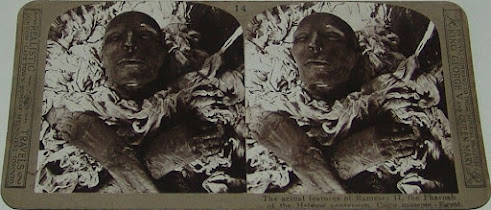
This card is a typical example of an Ingersoll card, which was made on thinner cardboard in the early twentieth century. 100 years later, these cards have not curled the way most older stereoviews have. Ingersoll cards are in color, but the same subjects can also be found in black and white. The reader would be advised to avoid buying Ingersoll, Keystone, and Underwood cards as singles, as most are very common and are a better value when buying in lots. Very similar cards were also distributed in cereal containers and are marked as such on the back.

 As stereoscope cards go, this is a visual time machine that takes the viewer back more than 100+ years to this museum display. Today, the pharaoh's mummy is no longer presented in his original coffin but in a hermetically sealed glass case under a piece of fine linen as befits the great king's dignity; unfortunately, the king's arms are no longer exposed. This, like many Keystone cards, can also be found in sepia by Underwood. The era of the stereoscope was between ca.1858-1939, which is around 80 years, so many cards, including this one, are very common even today, a century later, though some sellers will try to convince the buyer that they are rare; they are not. King Seti's mummy should be listed as a must-have in any Egyptian collection and is easily found for sale on the internet.
To start your own collection, buy a nice condition stereo-viewer with a few dozen cards. This should cost about $100. Make sure the sliding bar that holds the cards is present. Often they are sold missing this element, be picky, get a nice intact one, they are common. Back in the heyday of stereoviews, the machine was often given away for free.
Here we have a card by H. C. White whose production output began in 1899 and was almost as great as Keystone and Underwood, though the quality of White's stereoviews is of a higher standard than its rivals.

 Finally, many cards are overpriced, so shop around, you never know when something hard to find, like this card of Seti 1's mummy ( though it says it is the mummy of Ramses 2). Have fun!

Friday, October 19, 2018

History of Egypt, Chaldea, Syria, Babylonia, and Assyria Volume V


Gaston Maspero
The Grolier Society
London, UK
1904
Volume V


I have had this series of 114-year-old books for many years, but never read them. The author Gaston Maspero was the head of Egypt's Egyptian Museum and in charge of giving excavation permits in the late 19th century and early 20th century. Mr. Maspero was the chief Egyptologist and expert archaeologist of Oriental history. It must be noted that the use of and spelling of English words from 1904 differ from today's vocabulary. It must further be noted that interpretations of Egyptian hieroglyphs, particularly names, have also changed over the past century.

The book opens late in the reign of Thutmosis III, and the empire established by his predecessors is being expanded by King Thutmosis. The king's mummy is represented in now-familiar photographs, though the author believes the king's burial was at Deir el Bahri in a family vault. Gaston Maspero quickly passes through the reigns of Amenhotep II and Thutmosis IV, delving in more depth with Amenhotep III and the many monuments left to the posterity of this ruler. The Amarna correspondence opens the nature of the vassal lords who write to the king, greedily seeking greater and greater gifts to the point of exhaustion.

Interesting in reading an old book is, in this case, Mr. Maspero, as of writing, is unaware of the burial places of the kings of dynasty 18, though he is aware of the tomb of Amenhotep III in the Valley of the Kings. The author moves through the few identifiable relics of Amenhotep IV and the uncertainty of whether this Amenhotep and Akhenaton are the same king or if Amenhotep IV is a short-reigning predecessor of the heretic king. We are presented with the rise of the sun disk and the destruction of the traditional Theban deity Amon.

     "After having been for nearly two centuries almost the national head of Africa, Amon was degraded by a single blow to the secondary rank and languishing existence in which he had lived before the expulsion of the Hyksos. He had surrendered his sceptre as king of heaven and earth, not to any of his rivals who in old times had enjoyed the highest rank, but to an individual of a lower order, a sort of demigod, while he had thus become merely a local deity confined to the corner of the Said in which he had had his origin. There was not even left to him the peaceful possessions of this restricted domain, for he was obliged to act as host to the enemy that had deposed him: the temple of Atonu was erected at the door of his own sanctuary, and without leaving their courts the priests of Amon could hear at the hours of worship the chants intoned by hundreds of heretics in the temple of the disk."

The author puts forward life at Akhetaton with a rather romantic view of this king and his court, while his empire receded. Mr. Maspero is unimpressed with the king's crude tomb at the bottom of a ravine, far off in the desert. As the story passes, the heretic pharaoh and the royal actors, including Tutankhamun, become murky until the dynasty closes with the Pharaoh Horemheb.


The coronation of Ramses I founded the 19th Dynasty and brought a new family to the throne, and with his son and heir Seti I, order was restored to Egypt after the heresies that brought an end to the previous dynasty. Mr. Maspero puts forth King Seti's building works, which contain some of the finest reliefs ever placed on the walls of an Egyptian temple and in his tomb in the Valley of the Kings.

The successful reign of King Seti I reestablished Egyptian foreign stability that would be completed by his successor, the great King Ramesses II, in a peace treaty with the Hittites. Ramesses II's very long reign was, for the most part, peaceful, leaving the king to build new temples all over the country, including the restoration opportunities to engrave his name everywhere he could. War rises up again and is successfully put down during the reign of the great king's elderly successor, Merneptah. The short reign of Merneptah left behind a succession crisis involving a number of short-reigning descendants until only two decades after the great Ramesses II, his dynasty came to an end, being replaced by a dynasty of kings, almost all of whom were named after him.

The accession of Ramesses III brought to the throne the last great emperor of ancient Egypt's New Kingdom. The king's military victories brought peace, as they had his great predecessor Ramesses II a century earlier. These conquests he had his artisans engrave on the walls of his mortuary temple at Medinat-Habu. As the pharaoh grew older, a conspiracy developed in the king's harem as one of his lesser wives hoped to place her son on the throne, though not the legitimate heir. Magical figures were prepared and sacred spells were spoken, but the conspirators had an informant amongst their lot. A trial occurred at the end of which six women and forty men were put to death. Of the intended usurper prince, Mr. Maspero says,

     "They died of themselves," and the meaning of this phrase is indicated, I believe, by the appearance of one of the mummies disinterred at Deir el Bahari. The coffin in which it was placed was very plain, painted white and without inscription; the customary removal of entrails had not been effected. but the body was covered with a thick layer of natron, which was applied even to the skin itself and secured by wrappings. It makes one's flesh creep to look at it: The hands and feet are tied by strong bands, and are curled up as if under an intolerable pain; the abdomen is drawn up, the stomach projects like a ball, the chest is contracted, the head is thrown back, the face is contorted in a hideous grimace, the retracted lips expose the teeth, and the mouth is open as if to give utterance to a last despairing cry. The conviction is borne in upon us that the man was invested while still alive with the wrappings of the dead."2

With the death of Ramesses III, his successors, all named Ramesses, had short reigns and produced few monuments outside their tombs in the Valley of the Kings. Mr. Maspero gives an overview of the arts of the Theban empire, with high praise for the jewelry of Queen Ahhotep, about the masterpieces in royal jewelry from the Middle Empire.

Though published in 1904, the volume was a little out of date and likely written somewhere after the 1896 discovery by Flinders Petrie of the Merneptah Stelae and before the discovery of the tomb of Amenhotep II in March of 1898, of which the author is unaware. This book is for readers 18 and up; however, I doubt that it would have appeal to most readers, even those interested in ancient Egypt. The antique charm I suspected did not come to fruition; instead, the out-of-date archaeology mixed with the out-of-date hieroglyphic translations of names removed all impact of the author's words.


Notes:

1. page 93
2. pages 326-327

Saturday, September 29, 2018

History of Egypt, Chaldea, Syria, Babylonia, and Assyria, Volume II


Gaston Maspero
The Grolier Society
London, UK
1904
Volume 2

I have had this series of 114-year-old books for many years, but never read them. The author Gaston Maspero was the head of Egypt's Egyptian Museum and in charge of giving excavation permits in the late 19th century and early 20th century. Mr. Maspero was the chief Egyptologist and expert archaeologist of Oriental history. It must be noted that the use of and spelling of English words from 1904 differ from today's vocabulary. It must further be noted that interpretations of Egyptian hieroglyphs, particularly names, have also changed over the past century.

In volume two, we open with the political makeup of ancient Egypt and, in particular, the Memphite dynasties and their cemeteries at Gizah and Saqqara. The author deals with the inscriptions and decorations of the tombs of the nobles to tell of their services to the king and the enjoyments they hope to attain in the afterlife. Various methods are used to ensure this happiness after death, with offering chapels for priests and relatives to bring food and other offerings; these chapels often contain a statue of the deceased. Unfortunately for the deceased, these funerary venerations towards the dead within a couple of generations run out either of the finances to continue or relatives who remember the deceased ancestor. The backup plan includes images of offerings carved onto the walls of the funerary monument to sustain the dead for eternity.

The king and his family's roles are examined, with the king providing his people with their share of Egypt's bounty. The author goes on to describe the various functions the common or princely peoples played in the running of and distribution of the products of that land. These functionaries often obtain the hereditary departments of their fathers, though some are schooled as scribes.

Mr. Maspero delivers a rundown of each Egyptians lot in life and obligations to taxation from humble land-owners to the serfs who worked the land, digging and cleaning out canals to water the fields. The crafts created by the people to barter with others for needed or desired goods, including linen and sandals, rings made of copper, silver, and gold, or other such luxuries.

In chapter two, we are introduced to the Memphite dynasties of the Old Empire and the pinnacle of pyramid building. The technique of constructing pyramids from the 3rd Dynasty King Djoser to the 2nd King of the 4th Dynasty Khufu was a period of rapid learning with a couple of mistakes that produced hard-won lessons.

     "We rarely find at Medum finished and occupied sepulchres except those of individuals who had died shortly before or shortly after Snofrui. The mummy of Ranofir, found in one of them, shows how far the Egyptians had carried the art of embalming at this period. His body, though much shrunken, is well preserved: it had been clothed in some fine stuff, then covered over with a layer of resin, which a clever sculptor had modelled in such a manner as to present an image resembling the deceased; it was then rolled in three or four folds of thin and almost transparent gauze."1

The author describes the building of the pyramids and their apartments at Dashur by Snofrui and those at Giza by his successors. The details laid out for these constructions are largely out of date, though, because of the reliefs in these kings' courtiers' tombs surrounding the pyramids and stele from expeditions to the various quarries, including granite from Aswan, some semblance of the duties of the king's officials can be gleaned. Mr. Maspero puts forth the gifts the king gives his loyal courtiers, including their tombs near his pyramid, a funerary stele, statues, and offering tables, all cut from stone collected on behalf of the king.


The reliefs become repetitive in the tombs, while the statues were cut into one of a few traditional poses, with the heads left rough to receive the courtier's portrait. Of the reliefs, the author admires the skill with which varied animals are represented, but of the people in the reliefs, Mr. Maspero says,

     "The human figure is the least perfect: everyone is acquainted with those strange figures, whose heads in profile, with the eye drawn in full face, are attached to a torso seen from the front and supported by limbs in profile. These are truly anatomical monsters, and yet the appearance they present to us is neither laughable nor grotesque. The defective limbs are so deftly connected with those which are normal, that the whole becomes natural: the correct and fictitious lines are so ingeniously blended together that they seem to rise necessarily from each other. The actors in these dramas are constructed in such a paradoxical fashion that they could not exist in this world of ours; they live notwithstanding, despite the ordinary laws of physiology, and to any one who will take the trouble to regard them without prejudice, their strangeness will add a charm which is lacking in works more conformable to nature."2

The book is filled with many drawings taken from photographs with explanatory details of the object or scene presented. These include an 1881 picture of the author in the burial chamber of King Unas, standing in front of the king's sarcophagus. By the time of Dynasty V, the peak of the Memphite empire had passed leaving the kings of dynasties V. and VI much weakened with resources to build only smaller rubble filled pyramids at Saqqara unlike the great cut stone monuments at Gizeh, Dashur, and Medum but with the reign of King Unas the interiors of these cased rubble monuments now contained the Pyramid Texts carved on their walls. With the long reign of Pepi II, the Memphite empire became divided up by provincial nomarchs who claimed the power of the King of Upper and Lower Egypt when in reality these kings bore only local authority. Under these conditions, the two lands would remain divided for more than a century until unified by the Prince of Thebes.

Mr. Maspero directs the reader to the battles that ensued during the 7th to 10th dynasties between the Heracleopolitan princes and those at Thebes. It is the unification brought about by Mentuhotep II of the 11th Dynasty, the Theban princes attained the rightful kingship of the two lands, while the Theban kings of the 12th Dynasty extended the southern boundaries with fortresses, with each kings reign carrying away slaves, precious metals, turquoise, crops, and the defeated inhabitant's herds of livestock.

The kings of Dynasty 12 left many beautiful monuments, including the obelisk at Heliopolis now all that remains of the temple of the sun god Ra. Most of the monuments of this age have all but disappeared, leaving only the odd block to remember the kings of this great dynasty. We are introduced into the literature of this period, which has left us with such a tale as that of the Shipwrecked Sailor and the instructions of King Amenemhat I to his successor Usertasen I.

Certainly, volume two was much more enjoyable and easier to read than volume one was, this being the case by the more tangible relics of Pharaonic history compared with the abstraction in the mythology of the first book in this set. The book is not suitable for young readers and those looking for a romantic read on ancient Egypt, but for those in need to know.


Notes:

1. page 172
2. page 248