Thursday, January 8, 2026

An Unknown Woman-JE61052

                                         A Short about an Unknown Woman


The Director of the Bouloq museum, Gaston Maspero, c. 1886, About the mummy of Meritamon/Unknown woman "A."

"When the shroud was opened, we found ourselves in the presence of a mummy half stripped of its clothes, and with a peculiar appearance. Her head is leaning on her right shoulder, her jaw hanging, her mouth gaping, and pulled to the right. The chest is lifted violently, the shoulders are contracted, the arms are thrown forward in a stiff gesture, the hands are twisted, the right leg is entwined around the left, the feet are tensed: the entire body is like shaking with the last movements of agony. Is this an accidental fact, or should we believe that at the time the character was prepared for the grave, the custom had not yet prevailed to always place the corpses in an attitude of rest?  People were mummified as the dead took them.

 The Middle Kingdom tombs that I opened at Gebelein in 1886 give us valuable information in this regard. The four intact coffins that they returned to us contained mummies very similar to the mummy that concerns us. They too were in the attitude in which agony had left them, their heads bowed, their mouths gaping, their hands contracted, their legs drawn together.

Add to this other clues, the lightness of the body, the ease with which the skin breaks or detaches into scales, the defleshing of the skull; the mummy, which so resembles the mummies of Gebelien, has almost no resemblance to those of Ahmos I, of Queen Anhapou, of Saqnounri. It would rather be a mummy from the 12th or 13th dynasty, which the guardians would have removed from its tomb to replace the lost mummy of Queen Meritamon." 

Msr. Maspero may have been wrong about this mummy's pedigree, with the mummy actually being a king's daughter named Meritamon and not a replacement for an early 18th dynasty princess, but rather a late Middle Kingdom or Second Intermediate period royal mummy with that name. Little reason to doubt the inscription on her wrappings regarding her name, as most, if not all, the rest of the dockets on the royal mummies are accepted.  The princess's grave may have been found during the necropolis officials' recycling duties in Dynasty 21. Her mummy was removed and added to one of the royal mummy cachets. She may have joined the cache of the Dra Abu el-Naga's late 17th, early 18th dynasty mummies before the cache joined the Valley of the Kings mummies in tomb DB320, or was already there.

Why should there not be a late Middle Kingdom, early 17th-dynasty royal mummy mixed in with the New Kingdom royals?

Egypt's cemeteries are full of mummies from all periods, and it might be more surprising if there were no mummies buried hundreds of years before the New Kingdom royals and their immediate ancestors. Why would a recycled royal cache be completely homogeneous to one period? The ancient priests did not have convenient historical divisions like the New Kingdom, Middle Kingdom, or 12th dynasty, 13th dynasty, or 18th dynasty; these dynasties are of much later origin. It was rather a society that respected the "divine right of kings". A consecutive line of kings, comprising a multitude of competing families, today it's a Memphite king, tomorrow perhaps a Theban or Nubian king.

Mr. Maspero's recollection of the mummy under consideration is clearly that, as his description of the mummy has several inaccuracies, including his description of the position of hands and arms that the mummy does not possess. Msr. Maspero appears to be recalling the mummies he received from Gebelien that same year and sometime before his investigation of Princess Meritamon's mummy. His report on the mummy was written some time later from memory, and it appears that his description confuses details of Meritamon and the Gebelien mummies. Being that the inscription on Meritamon may be accurate, with the Middle Kingdom mummy not a replacement for Meritamon, but her actual mummy. 

With much certainty, when the 21st dynasty officials opened her tomb, it had been violently robbed and Meritamon's mummy torn apart. The officials would almost certainly have realized, stylistically, that they were dealing with a tomb much older than the 16th century B.C., though I am not sure that the age would have made a difference when putting a royal cache together, I am not sure one royal being much earlier would have made a difference to those collecting the belongings of the late 17th and early 18th dynasty royals! 

Recent studies of Meritamon's mummy have demonstrated she may have died of a heart attack, with some suggestion that she died suddenly and was discovered sometime later when rigor mortis had already set in. Rigor mortis sets in after a couple of hours but typically lasts up to 48 hours, as decomposition begins to take hold. While embalming takes time, it is long after rigor mortis has passed. I am never really convinced when the position of a mummy, including the so-called screaming mummies, has anything to do with rigor mortis, but more likely is a lazy embalmer doing a sloppy job, and no one will ever know, at least not for many years after the embalmer is dead and forgotten.

Notes:

The Royal Mummies by G.Elliot Smith, pgs. 6-7, JE61052 Mummy of unknown woman "A."

(Translations of Gaston Maspero quote)- Google Translate


External Resources:

National Museum of the Egyptian Civilization-Mummes Hall

Screaming Mummy

Sunday, August 10, 2025

How Cool is This a Tomb for Thutmosis II


Back in 2022, in a valley off the tourist track known as Wadi "C," The New Kingdom Research Foundation Mission led by Dr. Piers Litherland, in affiliation with the McDonald Institute for Archaeological Research at Cambridge University, in a joint venture with the Ministry for Tourism and Antiquities in the Western Wadis. Wow, that's a mouthful, but luckily, they still had time left over to excavate! The excavation is not done, so details are still to come. 

This discovery has been a noticeable missing link for more than a century, particularly in Egypt's Valley of the Kings. The missing tomb of Thutmosis II would be the earliest in that valley though the original tomb carved for his father Thutmosis I by Ineni is unknown a good candidate may be the Valley of Kings tomb KV20 generally associated with his daughter Hatshepsut the sister-wife of Thutmosis II would mean that Hatshepsut added herself including a recarved quartzite sarcophagus for her father to her father's tomb and with only one foundation deposit attributed to Hatshepsut no telling when the tomb was at least partly carved and if the deposit was added later like Hatshepsut's mummy. Being close to KV 20 tomb KV 60, I have also wondered if it was the tomb described by Ineni, with no one seeing no one hearing, and not terribly impressive, which may have been why Hatshepsut desired to rebury her father with more dignity. Or maybe it was carved as a needed storeroom for the valley workmen to carve KV20.

Valley of the Kings tomb KV42 has also been suggested. Although the foundation deposits say a queen of Thutmosis III, Hatshepset Meryet-ra. Non-royal canopic material found in the tomb indicates an inappropriate occupant of a royal tomb. Howard Carter believed that this material had been washed into the tomb and that nothing of Thutmosis II's funerary furniture had been found there.

I must say, I thought there was a good chance Thutmose II's tomb would be discovered in the foundations of Hatshepsut's Valley Temple at Deir el-Bahri; perhaps it will be there, having been relocated from the flooded Wadi "C" tomb. 


Notes:

1. Theban Mapping Project

2. Dr. Chris Naunton

3. Egypt Museum

4. Archaeology News

5. Thutmosis II

Thursday, June 15, 2023

Photographs and Stereoviews of Felix Bonfils

 Here is a self-portrait by 19th-century photographer of Middle Eastern scenes, Felix Bonfils.  He was one of the earliest commercial photographers of the monuments of Egypt, Greece, and Palestine, with this article's focus being on Egyptian monuments. The cards in question are from about c.1875, free of tourists, and many of these sites are unexcavated. These cards are known as stereoviews, which were meant to be viewed with a stereoscope. The era of the stereoscope is from approximately c.1860 to c.1939. Felix Bonfils' images were available as tourist souvenirs as individual photos and in books, as well as stereoviews. I have not corrected spelling from the quotes.


                                Card 42). Temple of Denderah, The Temple of Tentyris

The description on the back provides information that the temple was a relatively late construction, begun in the Ptolemaic era and completed by Nero, with the portico being built under Tiberius. 19th-century Egyptologist M. Maspero says of the goddess Hathor, for whom the temple is built, "represents beauty, order, and harmony; it is through her that all is renewed and subsists."

                                                         Card 47). Triumphal Gate

"The statues of Rameses are buried in sand up to the breast, "and are very much mutilated, like most statues of this description are. They are sitting statues and seem to have a total height of 13 meters." The scenes and inscription on the pylon refer to a campaign of Rameses and give a date more than 100 years before modern Egyptologists give for the reign of Rameses II.


                                              Card 56).  Dromos - Basement-Hall and Obelisk

"The gate of the second vestibule is 20 meters broad and 60 meters high; it opens on the great basement hall, or hall of pillars, constructed in the reign of Seti, father and predecessor of Rameses II. It is the largest that exists in any of the Egyptian monuments." The vertical walls of 30 meters high are decorated with religious pictures. The sculpture of this imposing vestibule belongs to the reign of Rameses II." We are again given an inaccurate date for the reign of this king.

                                              70.  Great Temple of Medinet-Abou

"The way to the (Kings' Gate) (Biban-el-Molouk) branches off to the left from a point where four roads meet, about a hundred meters north of the temple of Kournak. The plain is bounded here by ranges of steep calcareous hills, the rocky slopes of which have been roughly shaped into walls and pierced by numerous rows of sepulchres. These excavations are generally of small dimensions and decorated with sculpture. Their openings look, from a distance, like the windows of an immense building."

                                              79. Thebes - Second Hall of the Ramesseum 

"This hall is 41 meters wide and 31 meters deep. It is entered by three gates of black granite. The lateral walls are in ruins. The ceiling was supported by 48 columns arranged in 8 lines, but only five of these lines have remained upright. The ceiling was painted with golden stars on a blue ground."

                                                     84. Thebes - Rock Cut Sepulchres

"The great temple of Medinet-Abou, which is the work of Rameses III, was, like the temple of Tutmes, dedicated to Ammon, the solar God of Thebes. The first pylon, obstructed by ruins, leads to a court, 34 meters wide by ..." (Wrong description), while the number on the front and back of the card is 84, clearly this is a description of the temple of Ramesses. Sadly for me, this descriptive mistake is on perhaps my favorite of the stereoviews. The subject is one of the Theban cemeteries, probably Sheik-abd el-Gourna. Fun to see how it looked back in the late 1860s, early 1870s. Sure doesn't look like that anymore. Love it!

                                                     107. Propylon of The Temple of Isis

In my incomplete collection, I am particularly rich in cards from the Island of Philae. "The temple of Isis was begun in the reign of Ptolemy Philadelphus (285 - 247B.C.) and finished by his successor Ptolemy Euergetes (247 - 222 B.C)" "An inscription traced under its gate in 1799 informs us that the French army under Desaix, pursuing the Mamelucks, after the battle of the pyramids, reached Philae on the 13th of Vendemiaire in the year VII of the Republic (Oct. 4th, 1798). Fragments of obelisks and lions in red granite lie scattered about in front of the gateway."

                               114.Front and 115. Back; General View of the Temple of Phylae

"The worship of Isis maintained itself here as late as the close of the Sixth century after Christ. A Greek inscription of the chamber of Osiris, on the terrace of the great temple, proves that in the year 453 of our era, the goddess Isis still had her college of priests there. It was only in 577 that the worship of Isis was abolished and the Christian religion took its place. Bishop Theodore placed the Temple under the patronage of St-Stephen."

                                      132. Nubia - Perspective of the Temple of Kalabcheh

A number of these stereoviews are missing their back descriptions, including this card again, another favorite. A Roman-period construction, which in the 1960s was the temple of Kalabcheh, was rescued from the rise of the waters of Lake Nassar with the help of  Germany, and, in gratitude, the Egyptian government gave one of the temple's gates to Germany, which is somewhere in a museum in Berlin.

                                           136.Front and 135. Back, Temple of Dakkeh

"It was founded by Ptolemy Philadelphus by Ergamenus, King of Ethiopia, and continued by Philopator, Euregetes, and Augustus. Here, Petronius, in his march on Napata (B.C 23), defeated the troops of Candace, queen of the Ethiopians. The sculptures were covered with mud, which preserved them. In this temple was found a very curious monolith, an inscription relative to the gold mines of the desert.

Sunday, July 10, 2022

The Search for Senenmut


 The supposed success with finding King Hatshepset's mummy has brought to light many new questions about the location of the mummy of her foremost courtier, Senenmut. The thought that he may be among the unidentified royal mummies is intriguing. Although the discovery of Hatshepsut was made possible by the presence of a tooth, there is still considerable faith being placed in DNA, perhaps not with mummified tissue, but with bone or teeth.


Fortune has played its hand with the discovery of the intact tomb of Hatnofer and Ramose in the courtyard of their son Senenmut's prominent tomb at Sheik Abd el Qurna, TT71. Senenmut's tomb was explored by the Metropolitan Museum of Art's expedition in 1936, with the prize being a smashed brown quartzite sarcophagus. However, because it was unfinished, this has led some to believe that it was never used by Senenmut.


Though if it was used by Senenmut, hopefully his mummy was not in it at the time of its thorough destruction. The DNA of Hatnofer and Ramose may well identify their son out of the unknown royal mummies if his mummy has been found, though the chances of discovery of this individual are very remote

As it happens, Senenmut's father Ramose was a skeleton when found and was probably not mummified, while his mother was mummified, but since the excavation has become mostly a skeleton as well. This is good, as little damage will occur to their remains for DNA tests to find their famous son.

Among the male mummies from the cache tombs DB 320 and KV 35, which appear not to be direct family members of the Thutmoside king's families. Perhaps the best choice must be the mummy in the coffin inscribed for Nibsoni and known as "Unknown man C". Described in his 1912 "Mummies Royal" G. E. Smith refers to the mummy as "tall, vigorous man", "must have seemed a very giant amongst them, and is hardly likely to have sprung from such puny stock".


Mr. Smith makes this statement about the XVIII Dynasty kings found in the cache with our unknown man "C". He says little more about this mummy other than the mummy had been rifled in modern times before the official discovery of the tomb. Unfortunately, the research on this individual is sparse, though Mr. Smith believed the mummy's arm position suggests he dates before Thutmosis II.

A contender from around the correct period of the early Thutmoside king's including the reign of Hatshepsut. A couple of thoughts have come to me in that the king's cache tomb DB 320 held a box with the name of Hatshepsut, though the body of that king was not found in that cache. The box seems to be all that was collected from its find-spot unless it was found, and came into DB 320 with one of the mummies found there.


It has come to my notice that many, if not most, of Senenmut's statues are in good condition, suggesting that he and his statues did not face a thorough damnatio memoriae after death, and that might make the smashed sarcophagus an anomaly that could have occurred hundreds or even thousands of years after Senenmut's passing.

From the king's cache at Deir el-Bahari was found the small box that contained the tooth belonging to the mummy identified as Hatshepsut, found in Valley of the Kings tomb KV 60. Somehow, the box became separate from Hatshepsut's burial. Hard to believe that the reburial commission would take the box and leave the king's mummy behind. There has to be the thought that her mummy was already gone by the time the reburial commission entered whichever tomb the box was found in. Perhaps removed by Thutmosis III, Hatshepsut's successor.

Senenmut had two choices for his burial, including a tomb inside the Hatshepsut quarry near her mortuary temple at Deir el-Bahari. The tomb, when found by the Metropolitan Museum of Art's excavations, was completely empty. It suggests that he was buried in his extremely prominent hilltop tomb at Sheik Abd el-Qurna, where the smashed sarcophagus was found, and where his parents were buried.

Still, he may have died before Hatshepsut and been buried in her tomb. Thutmosis III or his successors may have removed the queen to KV 60 and left Senenmut and the box still in the tomb when found by the reburial commission, and as such, both mummy and box may have ended up together in tomb DB 320.


Notes:

Saturday, January 8, 2022

Collecting Ancient Egypt in Stereo cards

The above is a 1870s view of the Sphinx and the Great Pyramid at Giza. This is an early, very rare French tissue card that has a second layer of tissue behind the tissue photograph, which is colored in absurd pink and green, so that when the light passes through, these colors show through. As one can imagine, these tissue windows are easily broken. Egypt is an uncommon subject of these tissue cards, which often center around prominent rooms in European palaces and gardens.
Francis Frith was an early photographer who photographed Egypt's and Nubia's monuments in the late 1850s. The above example shows the now lost temple of Gerf Hussein, of which today the temple's inner sanctum lies at the bottom of Lake Nassar. Note the photographer's signature in the bottom left corner.


Felix Bonfils was an early photographer of the Middle East, including Egypt, and was the first photographer to market images of the Middle East on a large scale, certainly nothing like the companies that followed, like Keystone or Underwood & Underwood. Here we have the temple of Dendur, which today resides at 1000 5th Avenue, New York, in the Metropolitan Museum of Art. Felix Bonfils cards in good condition run from around $50-$100 and up each.
This card is a typical example of an Ingersoll card, which was made on thinner cardboard in the early twentieth century. 100 years later, these cards have not curled the way most older stereoviews have. Ingersoll cards are in color, but the same subjects can also be found in black and white. The reader would be advised to avoid buying Ingersoll, Keystone, and Underwood cards as singles, as most are very common and are a better value when buying in lots. Very similar cards were also distributed in cereal containers and are marked as such on the back.

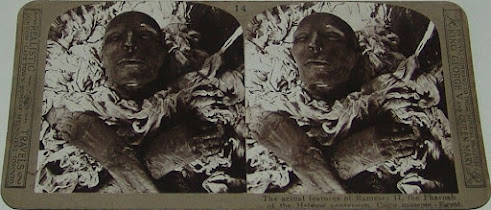
 As stereoscope cards go, this is a visual time machine that takes the viewer back more than 100+ years to this museum display. Today, the pharaoh's mummy is no longer presented in his original coffin but in a hermetically sealed glass case under a piece of fine linen as befits the great king's dignity; unfortunately, the king's arms are no longer exposed. This, like many Keystone cards, can also be found in sepia by Underwood. The era of the stereoscope was between ca.1858-1939, which is around 80 years, so many cards, including this one, are very common even today, a century later, though some sellers will try to convince the buyer that they are rare; they are not. King Seti's mummy should be listed as a must-have in any Egyptian collection and is easily found for sale on the internet.
To start your own collection, buy a nice condition stereo-viewer with a few dozen cards. This should cost about $100. Make sure the sliding bar that holds the cards is present. Often they are sold missing this element, be picky, get a nice intact one, they are common. Back in the heyday of stereoviews, the machine was often given away for free.
Here we have a card by H. C. White whose production output began in 1899 and was almost as great as Keystone and Underwood, though the quality of White's stereoviews is of a higher standard than its rivals.

 Finally, many cards are overpriced, so shop around, you never know when something hard to find, like this card of Seti 1's mummy ( though it says it is the mummy of Ramses 2). Have fun!

Friday, October 19, 2018

History of Egypt, Chaldea, Syria, Babylonia, and Assyria Volume V


Gaston Maspero
The Grolier Society
London, UK
1904
Volume V


I have had this series of 114-year-old books for many years, but never read them. The author Gaston Maspero was the head of Egypt's Egyptian Museum and in charge of giving excavation permits in the late 19th century and early 20th century. Mr. Maspero was the chief Egyptologist and expert archaeologist of Oriental history. It must be noted that the use of and spelling of English words from 1904 differ from today's vocabulary. It must further be noted that interpretations of Egyptian hieroglyphs, particularly names, have also changed over the past century.

The book opens late in the reign of Thutmosis III, and the empire established by his predecessors is being expanded by King Thutmosis. The king's mummy is represented in now-familiar photographs, though the author believes the king's burial was at Deir el Bahri in a family vault. Gaston Maspero quickly passes through the reigns of Amenhotep II and Thutmosis IV, delving in more depth with Amenhotep III and the many monuments left to the posterity of this ruler. The Amarna correspondence opens the nature of the vassal lords who write to the king, greedily seeking greater and greater gifts to the point of exhaustion.

Interesting in reading an old book is, in this case, Mr. Maspero, as of writing, is unaware of the burial places of the kings of dynasty 18, though he is aware of the tomb of Amenhotep III in the Valley of the Kings. The author moves through the few identifiable relics of Amenhotep IV and the uncertainty of whether this Amenhotep and Akhenaton are the same king or if Amenhotep IV is a short-reigning predecessor of the heretic king. We are presented with the rise of the sun disk and the destruction of the traditional Theban deity Amon.

     "After having been for nearly two centuries almost the national head of Africa, Amon was degraded by a single blow to the secondary rank and languishing existence in which he had lived before the expulsion of the Hyksos. He had surrendered his sceptre as king of heaven and earth, not to any of his rivals who in old times had enjoyed the highest rank, but to an individual of a lower order, a sort of demigod, while he had thus become merely a local deity confined to the corner of the Said in which he had had his origin. There was not even left to him the peaceful possessions of this restricted domain, for he was obliged to act as host to the enemy that had deposed him: the temple of Atonu was erected at the door of his own sanctuary, and without leaving their courts the priests of Amon could hear at the hours of worship the chants intoned by hundreds of heretics in the temple of the disk."

The author puts forward life at Akhetaton with a rather romantic view of this king and his court, while his empire receded. Mr. Maspero is unimpressed with the king's crude tomb at the bottom of a ravine, far off in the desert. As the story passes, the heretic pharaoh and the royal actors, including Tutankhamun, become murky until the dynasty closes with the Pharaoh Horemheb.


The coronation of Ramses I founded the 19th Dynasty and brought a new family to the throne, and with his son and heir Seti I, order was restored to Egypt after the heresies that brought an end to the previous dynasty. Mr. Maspero puts forth King Seti's building works, which contain some of the finest reliefs ever placed on the walls of an Egyptian temple and in his tomb in the Valley of the Kings.

The successful reign of King Seti I reestablished Egyptian foreign stability that would be completed by his successor, the great King Ramesses II, in a peace treaty with the Hittites. Ramesses II's very long reign was, for the most part, peaceful, leaving the king to build new temples all over the country, including the restoration opportunities to engrave his name everywhere he could. War rises up again and is successfully put down during the reign of the great king's elderly successor, Merneptah. The short reign of Merneptah left behind a succession crisis involving a number of short-reigning descendants until only two decades after the great Ramesses II, his dynasty came to an end, being replaced by a dynasty of kings, almost all of whom were named after him.

The accession of Ramesses III brought to the throne the last great emperor of ancient Egypt's New Kingdom. The king's military victories brought peace, as they had his great predecessor Ramesses II a century earlier. These conquests he had his artisans engrave on the walls of his mortuary temple at Medinat-Habu. As the pharaoh grew older, a conspiracy developed in the king's harem as one of his lesser wives hoped to place her son on the throne, though not the legitimate heir. Magical figures were prepared and sacred spells were spoken, but the conspirators had an informant amongst their lot. A trial occurred at the end of which six women and forty men were put to death. Of the intended usurper prince, Mr. Maspero says,

     "They died of themselves," and the meaning of this phrase is indicated, I believe, by the appearance of one of the mummies disinterred at Deir el Bahari. The coffin in which it was placed was very plain, painted white and without inscription; the customary removal of entrails had not been effected. but the body was covered with a thick layer of natron, which was applied even to the skin itself and secured by wrappings. It makes one's flesh creep to look at it: The hands and feet are tied by strong bands, and are curled up as if under an intolerable pain; the abdomen is drawn up, the stomach projects like a ball, the chest is contracted, the head is thrown back, the face is contorted in a hideous grimace, the retracted lips expose the teeth, and the mouth is open as if to give utterance to a last despairing cry. The conviction is borne in upon us that the man was invested while still alive with the wrappings of the dead."2

With the death of Ramesses III, his successors, all named Ramesses, had short reigns and produced few monuments outside their tombs in the Valley of the Kings. Mr. Maspero gives an overview of the arts of the Theban empire, with high praise for the jewelry of Queen Ahhotep, about the masterpieces in royal jewelry from the Middle Empire.

Though published in 1904, the volume was a little out of date and likely written somewhere after the 1896 discovery by Flinders Petrie of the Merneptah Stelae and before the discovery of the tomb of Amenhotep II in March of 1898, of which the author is unaware. This book is for readers 18 and up; however, I doubt that it would have appeal to most readers, even those interested in ancient Egypt. The antique charm I suspected did not come to fruition; instead, the out-of-date archaeology mixed with the out-of-date hieroglyphic translations of names removed all impact of the author's words.


Notes:

1. page 93
2. pages 326-327

Saturday, September 29, 2018

History of Egypt, Chaldea, Syria, Babylonia, and Assyria, Volume II


Gaston Maspero
The Grolier Society
London, UK
1904
Volume 2

I have had this series of 114-year-old books for many years, but never read them. The author Gaston Maspero was the head of Egypt's Egyptian Museum and in charge of giving excavation permits in the late 19th century and early 20th century. Mr. Maspero was the chief Egyptologist and expert archaeologist of Oriental history. It must be noted that the use of and spelling of English words from 1904 differ from today's vocabulary. It must further be noted that interpretations of Egyptian hieroglyphs, particularly names, have also changed over the past century.

In volume two, we open with the political makeup of ancient Egypt and, in particular, the Memphite dynasties and their cemeteries at Gizah and Saqqara. The author deals with the inscriptions and decorations of the tombs of the nobles to tell of their services to the king and the enjoyments they hope to attain in the afterlife. Various methods are used to ensure this happiness after death, with offering chapels for priests and relatives to bring food and other offerings; these chapels often contain a statue of the deceased. Unfortunately for the deceased, these funerary venerations towards the dead within a couple of generations run out either of the finances to continue or relatives who remember the deceased ancestor. The backup plan includes images of offerings carved onto the walls of the funerary monument to sustain the dead for eternity.

The king and his family's roles are examined, with the king providing his people with their share of Egypt's bounty. The author goes on to describe the various functions the common or princely peoples played in the running of and distribution of the products of that land. These functionaries often obtain the hereditary departments of their fathers, though some are schooled as scribes.

Mr. Maspero delivers a rundown of each Egyptians lot in life and obligations to taxation from humble land-owners to the serfs who worked the land, digging and cleaning out canals to water the fields. The crafts created by the people to barter with others for needed or desired goods, including linen and sandals, rings made of copper, silver, and gold, or other such luxuries.

In chapter two, we are introduced to the Memphite dynasties of the Old Empire and the pinnacle of pyramid building. The technique of constructing pyramids from the 3rd Dynasty King Djoser to the 2nd King of the 4th Dynasty Khufu was a period of rapid learning with a couple of mistakes that produced hard-won lessons.

     "We rarely find at Medum finished and occupied sepulchres except those of individuals who had died shortly before or shortly after Snofrui. The mummy of Ranofir, found in one of them, shows how far the Egyptians had carried the art of embalming at this period. His body, though much shrunken, is well preserved: it had been clothed in some fine stuff, then covered over with a layer of resin, which a clever sculptor had modelled in such a manner as to present an image resembling the deceased; it was then rolled in three or four folds of thin and almost transparent gauze."1

The author describes the building of the pyramids and their apartments at Dashur by Snofrui and those at Giza by his successors. The details laid out for these constructions are largely out of date, though, because of the reliefs in these kings' courtiers' tombs surrounding the pyramids and stele from expeditions to the various quarries, including granite from Aswan, some semblance of the duties of the king's officials can be gleaned. Mr. Maspero puts forth the gifts the king gives his loyal courtiers, including their tombs near his pyramid, a funerary stele, statues, and offering tables, all cut from stone collected on behalf of the king.


The reliefs become repetitive in the tombs, while the statues were cut into one of a few traditional poses, with the heads left rough to receive the courtier's portrait. Of the reliefs, the author admires the skill with which varied animals are represented, but of the people in the reliefs, Mr. Maspero says,

     "The human figure is the least perfect: everyone is acquainted with those strange figures, whose heads in profile, with the eye drawn in full face, are attached to a torso seen from the front and supported by limbs in profile. These are truly anatomical monsters, and yet the appearance they present to us is neither laughable nor grotesque. The defective limbs are so deftly connected with those which are normal, that the whole becomes natural: the correct and fictitious lines are so ingeniously blended together that they seem to rise necessarily from each other. The actors in these dramas are constructed in such a paradoxical fashion that they could not exist in this world of ours; they live notwithstanding, despite the ordinary laws of physiology, and to any one who will take the trouble to regard them without prejudice, their strangeness will add a charm which is lacking in works more conformable to nature."2

The book is filled with many drawings taken from photographs with explanatory details of the object or scene presented. These include an 1881 picture of the author in the burial chamber of King Unas, standing in front of the king's sarcophagus. By the time of Dynasty V, the peak of the Memphite empire had passed leaving the kings of dynasties V. and VI much weakened with resources to build only smaller rubble filled pyramids at Saqqara unlike the great cut stone monuments at Gizeh, Dashur, and Medum but with the reign of King Unas the interiors of these cased rubble monuments now contained the Pyramid Texts carved on their walls. With the long reign of Pepi II, the Memphite empire became divided up by provincial nomarchs who claimed the power of the King of Upper and Lower Egypt when in reality these kings bore only local authority. Under these conditions, the two lands would remain divided for more than a century until unified by the Prince of Thebes.

Mr. Maspero directs the reader to the battles that ensued during the 7th to 10th dynasties between the Heracleopolitan princes and those at Thebes. It is the unification brought about by Mentuhotep II of the 11th Dynasty, the Theban princes attained the rightful kingship of the two lands, while the Theban kings of the 12th Dynasty extended the southern boundaries with fortresses, with each kings reign carrying away slaves, precious metals, turquoise, crops, and the defeated inhabitant's herds of livestock.

The kings of Dynasty 12 left many beautiful monuments, including the obelisk at Heliopolis now all that remains of the temple of the sun god Ra. Most of the monuments of this age have all but disappeared, leaving only the odd block to remember the kings of this great dynasty. We are introduced into the literature of this period, which has left us with such a tale as that of the Shipwrecked Sailor and the instructions of King Amenemhat I to his successor Usertasen I.

Certainly, volume two was much more enjoyable and easier to read than volume one was, this being the case by the more tangible relics of Pharaonic history compared with the abstraction in the mythology of the first book in this set. The book is not suitable for young readers and those looking for a romantic read on ancient Egypt, but for those in need to know.


Notes:

1. page 172
2. page 248

Tuesday, September 11, 2018

The Ghosts of Brazil's National Museum


The tragic fire of September 2, 2018, which destroyed Brazil's National Museum, as well as most of its collections, took with it one of South America's most important Egyptian collections, likely including the lovely 23rd Dynasty mummy Sha-Amun-em-su and her coffin. The museum's website says this of her,

"This coffin was a present offered by the Khedive of Egypt, Ismail, to the Emperor of Brazil, D. Pedro II, when he visited Egypt in 1876. D. Pedro II kept it standing upright in his study, near a window open one day, when the coffin was hit by a window-catch, breaking part of its side. Its left side was then repaired; this feature is still visible today."

Sha-Amun-em-su was not the only mummy in the collection, along with 700 other ancient Egyptian artifacts. The museum's display of at least 21 stone stele probably has the best chance of having survived the fire, though if they have, their likely in shattered pieces, but some hope lingers at least to this writer. One of my favorites of these monuments is a 19th Dynasty limestone stele belonging to a man named Amenemopet.


The unfortunate fire could have been avoided had the 200-year-old palace been subject to regular upgrades over the years. So often, we see museums around the world that do not seem to benefit from their millions of visitors

I would hope that the curators and trustees of the world's ancient Egyptian collections will be able to reach into their reserve collections and donate some of their duplicates to help replenish this Brazilian institution of learning, so that one day Brazil's 200 million-plus people and future generations will again be excited and inspired by ancient Egypt in Brazil. But first, a new museum needs to be found or rebuilt with proper funding, perhaps, with foreign donations to help, so that any future collection in Brazil will not be relegated to another neglected building.


Notes:

1. Images of the coffin of Sha-Amun-em-su and the stele of Amenemopet by Luiza G. da Silva, Antonio Brancaglion, National Museum of Brazil

2. Seshat: Egyptological Laboratory of the National Museum of Brazil

3. Photo of the mummy known as "Princess Kherima" 

4. Wikipedia for more photos


Friday, August 24, 2018

The Pyramids by Ahmed Fakhry


Ahmed Fakhry
The University of Chicago Press
1961
U.S.A.
Library of Congress No. 61-8654

This 249-page read from the University of Chicago Press contains many images and schematics to help in the explanation of the monuments, including, at the back of the book, a listing of all the known Egyptian pyramids as of 1961 and their base measurements. The author is extremely knowledgeable on the subject and introduces interesting information that I have not heard before. Mr. Fakhry explains the pyramids in their apparent chronological order, including their associated mortuary and valley temples.

     "The approach to the southern pyramid complex of King Snefru at Dashur is through a Valley Temple situated near the edge of the cultivation. At the time of writing, this is the earliest Valley Temple discovered. "... there was no temple of this type for the Step Pyramid of Zoser, nor any remains of a causeway which would suggest that such a building had never existed."1

The author explains the rise of building these monuments, culminating in the great pyramids on the Giza plateau and their accompanying causeways, temples, and boat pits, including the discovery of royal statues found during excavations. We are told about the previous excavator's discoveries at the various sites, including the measurements of the monuments, which at times caused me to glaze over. Mr. Fakhry gives admirable insight into the enigmatic pyramid site at Abu Rawash, excavated in 1901 by E. S. Chassinat.

     "South of the Mortuary Temple on the east side is a large rock-cut boat pit. With its long axis pointing north-south, it measures 35 meters long, 3.75 meters wide at its widest part, and 9.3 meters deep. At the bottom of the debris filling this boat pit, Chassinat found three beautiful heads from statues of Rededef. They had been wantonly knocked off the bodies and flung there during the upheavals that followed the Old Kingdom. (Two of the heads are now in the Louvre, and one is in the Cairo Museum.)"2

When Perring and Vyse entered the third pyramid at Giza, that of Menkure, in the late 1830's they found a wooden coffin and the mummified body of a man. The inscription on the late period style coffin reads.

     "Osiris, the King of Upper and Lower Egypt, Menkure, living forever. Born of the sky, conceived by Nut, heir of Geb, his beloved. Thy mother Nut spreads herself over thee in her name of 'Mystery of Heaven.' She caused thee to be a god, in thy name of 'God,' O King of Upper and Lower Egypt, Menkure, living forever."3

As the Old Kingdom descended into anarchy, the pyramids of the fifth and sixth dynasties became smaller and were built in poorer quality work. The burial practices changed, and the pyramid texts appeared carved on the walls of these kings and a number of their queens. It is during the following period that most of these monuments were opened, with the royal burials robbed and destroyed, leaving only fragments of their once opulent contents.

The rise of the Princes of Thebes in the expulsion of the foreign overlords who ruled over the northern half of Egypt resulted in the reunification of the country with a period of great prosperity. It is in the Twelfth Dynasty that the kings returned to building pyramids, but this time with complex corridors and hidden entrances to baffle looters who found the entrances of the Old Kingdom pyramids in the north face.

In Egypt, the pyramid age dwindles down to small mudbrick pyramids above simple tombs, both royal and commoner. In the Twenty-Fifth Dynasty, pyramidal burials were found south of Egypt in Sudan at sites like El Kurru, Kerma, and later at Moroe. These royal constructions are much smaller and much steeper.

Mr. Fakhry's presentation of the pyramids was both interesting and knowledgeable, as I had suspected he would be, and though almost sixty years later, this book is well put forward and suitable for ages ten and up.

     "...they are perished also,
Those walls of Thebes which the Muses built;
But the wall that belongs to me has no fear of war;
It knows not either the ravage of war or the sobbing.
It rejoices always in feasts and banquets,
And the choruses of young people, united from all parts.
We hear the flutes, not the trumpet of war,
And the blood that waters the earth is of the sacrificial bulls,
Not from the slashed throats of men.
Our ornaments are the festive clothes, not the arms of war,
And our hands hold not the scimitar,
But the fraternal cup of the banquet;
And all night long while the sacrifices are burning
We sing hymns to Harmakhis (Hor-em-akhet),
And our heads are decorated with garlands." 4


Notes:

1. page 80
2. page 129
3. page 150
4. page 165, An ancient Greek visitor to the pyramids on the Giza plateau wrote this poem on a toe of the Great Sphinx.

Tuesday, August 21, 2018

The Tombs of the Kings


Where the mummied Kings of Egypt,wrapped in linen fold on fold,
Couched for ages in their coffins, crowned with crowns of dusky gold,

Lie in subterranean chambers, biding to the day of doom,
Counterfeit life's hollow semblance in each mazy mountain tomb,

Grisly in their gilded coffins, mocking masks of skin and bone,
Yet remain in change unchanging, balking Nature of her own;

Mured in mighty Mausoleums, walled in from the night and day,
Lo, the mortal Kings of Egypt hold immortal Death at bay.

For - so spake the Kings of Egypt - those colossal ones whose hand
Held the peoples from Pitasa to the Kheta's conquered land;

Who, with flash and clash of lances and war chariots, stormed and won
Many a town of stiff-necked Syria to high-towering Askalon:

"We have been the faithful stewards of the deathless gods on high;
We have built them starry temples underneath the starry sky.

"We have smitten rebel nations, as a child is whipped with rods:
We the living carnation of imperishable gods.

"Shall we suffer Death to trample us to nothingness? and must
We be scattered, as the whirlwind blows about the desert dust?

"No! Death shall not dare come near us, nor Corruption shall not lay
Hands upon our sacred bodies, incorruptible as day.

"Let us put a bit and bridle, and rein in Time's headlong course;
Let us ride him through the ages as a master rides his horse.

"On the changing earth unchanging let us bide till Time shall end,
Till, reborn in blest Osiris, mortal with immortal blend."

Yes, so spake the Kings of Egypt, they whose lightest word was law,
At whose nod the far-off nations cowered, stricken dumb with awe.

And Fate left the haughty rulers to work out their monstrous doom;
And, embalmed with myrrh and ointments, they were carried to the tomb;

Through the gate of Bab-el-Molouk, where the sulpher hill lie bare,
Where no green thing casts a shadow in the noon's tremendous glare;

Where the unveiled Blue of heaven in its bare intensity
Weighs upon the awe-struck spirit with the world's immensity;

Through the Vale of Desolation, where no beast or bird draws breath,
To the Coffin Hills of Tuat - the Metropolis of Death.

Down - down - down into the darkness, where, on either hand, dread fate
In the semblance of a serpent, watches by the dolorous gate;

Down - down - down into the darkness, where no gleam of sun or star
Sheds its purifying radiance from the living world afar;

Where in labyrinthine windings, darkly hidden, down and down,-
Proudly on his marble pillow, with old Egypt's double crown,

And his mien of cold commandment, grasping still his staff of state,
Rests the mightiest of the Pharaohs, whom the world surnamed the great.

Swathed in fine Sidonian linen, crossed hands folded on the breast,
There the mummied Kings of Egypt lie within each painted chest.

And upon their dusky foreheads Pleiades of flaming gems,
Glowing through the nether darkness, flash from luminous diadems.

Where is Memphis? Like a mirage, melted into empty air:
But these royal gems yet sparkle richly on their raven hair.

Where is Thebes in all her glory, with her gates of beaten gold?
Where Syene, or that marvel, Heliopolis of old?

Where is Edfu? Where Abydos? Where those pillared towns of yore
Whose auroral temples glittered by the Nile's thick-peopled shore?

Gone as evanescent cloudlands, alplike in the afterglow;
But these Kings hold fast their bodies of four thousand years ago.

Sealed up in their Mausoleums, in the bowels of the hills,
There they hide from dissolution and Deaths swiftly grinding mills.

Scattering fire, Uraeus serpents guard the Tombs' tremendous gate;
While Troth holds the trembling balance, weighs the heat and seals its fate.

And a multitude of mummies in the swaddling clothes of death,
Ferried o'er the sullen river, on and on still hasteneth.

And around them and above them, blazoned on the rocky walls,
Crowned with stars, enlaced by serpents, in divine processionals,

Ibis-headed, jackal-featured, vulture-hooded, pass on high,
Gods on gods through Time's perspectives - pilgrims of Eternity.

There, revealed by fitful flashes, in a gloom that may be felt,
Wild Chimeras flash from darkness, glittering like Orion's belt.

And on high, o'er shining waters, in their barks the gods sail by,
In the Sunboat and in the Moonboat, rowed across the rose-hued sky.

Night, that was before creation, watches sphinxlike, starred with eyes,
And the hours and days are passing, and the years and centuries.

But these mummied Kings of Egypt, pictures of a parished race,
Lie, of busy Death forgotten, face by immemorial face.

Though the glorious sun above them, burning on the naked plain,
Clothes the empty wilderness with the golden, glowing grain;

Though the balmy Moon above them, floating in the milky Blue,
Fills the empty wilderness with a silver fall of dew;

Though life comes and flies unresting, like the shadow which a dove
Casts upon the Sphinx, in passing, for a moment from above;-

Still these mummied Kings of Egypt, wrapped in linen, fold on fold,
Bide through ages in their coffins, crowned with crowns of dusky gold.

Had the sun once brushed them lightly, or a breath of air, they must
Instantaneously have crumbled into evanescent dust.

Pale and passive in their prisons, they have conquered, chained to death;
And their lineaments look living now as when they last drew breath!

Have they conquered? Oh, the pity of those Kings within their tombs,
Locked in stony isolation in those petrifying glooms!

Motionless where all is motion in a rolling Universe,
Heaven, by answering their prayer, turned it to a deadly curse.

Let them fixed where all is fluid in a world of star-winged skies;
Where, in myriad transformations, all things pass and nothing dies;

Nothing dies but what is tethered, kept when Time would set it free,
To fulfill Thought's yearning tension upward through Eternity.

Mathilde Blind
1847-1896

Source: The Universal Anthology, edited by Richard Garnett, The Clarke Company, limited, London, 1899, Vol. I, pgs. 116-119.

Wednesday, August 8, 2018

The Secrets of the Pyramids


Michael Feeley
Sazmick Books
2017
United Kingdom
ISBN: 978-0-9954554-4-3

With all the Egyptian books I have reviewed, I can usually get a good sense of the content, the author's knowledge, and sense of the writer's taste. It appears from the start that this book will be spiritual by nature. The book opens with several quotes, including one from Leonardo Da Vinci, but more concerning is a quote from fiction writer Dan Brown, author of The Da Vinci Code, which left me cringing, as I am no fan of contorting history to fit into a narrative, no matter how entertaining.

The author is apparently a descendant of Celtic Irish kings and a former United Kingdom police detective, the latter gives me some hope of a trained, inquisitive mind. The author believes in paranormal and supernatural powers and, on a couple of occasions, has witnessed dimensional portals open up in front of him and other hallucinations. I am only at the biography of the author, and trepidation is rushing over this reviewer.

In the introduction, Mr. Freeley puts forward the very popular belief that an advanced civilization has left a message to humanity encoded within the monuments. This nineteenth-century theory is usually linked exclusively to the Great Pyramid. The reader is met with a hieroglyphic alphabet of twenty-two letters, which I have never seen before, and which are anything but Egyptian hieroglyphics. The author gives dictionary definitions of enlightenment, consciousness, and Kundalini Awakening in the concept of Dharma.

Before the author's trip to Egypt, he is contacted by a UK Psychic who cannot spell properly. In her note includes the sentence " You need to first look passed the tourism" in large letters. Chapter one opens with Mr. Freeley's trip to Egypt, including the hope to meet the famous Dr. Zahi Hawass, whose last name is misspelled. The chapter ends with another example of the misspelled word passed when the word intended was past.

In chapter two, the author presents a good traditional view of Egypt, with the belief that slaves built the pyramids, for which there is no evidence. Mr. Freeley then begins with explanations of the meaning of words, including the famous so-called helicopter found carved in a lintel of the temple of Seti I at Abydos. Heli, meaning Helios/sun and copter with Coptics together meaning "Christian Egyptian", and including the god Horus, whose name is an anagram meaning hour(s).

The book moves forward to the gods of ancient Egypt and the roots of Egyptian royalty and government. We, for some reason, are on to the transcript of the 1953 coronation ceremonies of England's Queen Elizabeth II, which occupies more than thirty pages of a 131-page book.

The author is all over the place in this book and cannot be recommended as serious reading for Egyptologists and Egyptology lovers. Unfortunately, the book is filled with spelling mistakes and dubious theories that are not suitable for young people to learn from, nor was it particularly entertaining. In the end, "The Secrets of the Pyramids" should remain a secret.


Sunday, July 8, 2018

The Colors of Ancient Egypt


This is a unique opportunity to help fund an upcoming exhibition at the world-famous Egyptian Museum in Cairo, which will run through November 2018. The show uses technology to recolor reliefs using "image mapping" to restore the objects to how they looked in ancient Egypt.

The Colors of Ancient Egypt

Indiegogo funding page for The Colors of Ancient Egypt

Wednesday, June 6, 2018

The Mummies of Yuya and Thuya


     Recently, I have been looking at antique stereoviews for material to add to this blog, and this is an exciting find. The card is from c.1908, and the mummies pictured were found just a couple of years earlier in their tomb in the Valley of the Kings, which had not been touched in thousands of years, and with the contents in a near-perfect state of preservation. The tomb today is known as KV 46 contains the two mummies presented here, the parents of the great royal wife of Amenhotep III, Queen Tiye. The mummy of Queen Tiye's mother Thuya, is pictured in front, with the queen's father Yuya pictured behind. In the background are some familiar pieces of their burial.

The 110-year-old stereoview says that the mummies are 3000-4000 years old, when in reality they are from the middle of the 14th century BC. The description also claims that the mummies are at Gizeh when the reality is that they are displayed in the nearly brand new Cairo Egyptian Museum, opened in 1902.

Back in the late 1980's author Ahmed Osman wrote the fascinating book "Stranger in the Valley of the Kings" in which the author identified Yuya with the Biblical Patriarch Joseph.

Notes:

My short book review "Stranger in the Valley of the Kings"

Saturday, May 19, 2018

Tutankhamun Treasures: Press Release Canada 1964-65


Here I have a press release concerning the 1964-65 tour of Canada, creatively named Tutankhamun Treasures, and I know if you have ever seen an exhibit of Tutankhamun treasures, no doubt you have seen one of these canopic coffinettes. The air miles must be through the roof on this thing. The show appears to have had only a little less than three dozen objects and all of which are small. This tour of Canada was only one of two Tutankhamun exhibitions touring the world at the time to raise funds and donations to help fund the rescue of the temple of Ramses II at Abu Simbel before it descended beneath the rising waters of Lake Nassar after the building of the Aswan High Dam.

The venues for the Canadian tour were:

The National Gallery of Canada
The Montreal Museum of Fine Arts
The Royal Ontario Museum of Archaeology
The Winnipeg Art Gallery
The Vancouver Art Gallery
Le Musée du Québec

The guide begins with a brief foreword by the Director of The National Gallery of Canada, Charles F. Comfort, who explains the motivation for the show, as well as thanking those who helped with the exhibition. The introduction covers the same issues, except that this time it is the United Arab Republic's Minister of Culture and National Guidance, Abdel Kader Hatem.

A short history of the life of Tutankhamun and the times in which he lived is well presented by Rudolf Anthes from the University Museum, University of Pennsylvania. This is followed by the objects in the exhibition, all of which are represented by black and white photographs

List of Objects:

1. Gold Dagger and Sheath found on the mummy of the king
2. Gold Coffinette
3. Gold pectoral inlaid with glass and semi-precious stones with a chain and a heart counterpoise
4. Gold and blue glass flail
5. Gold and blue glass crook
6. Large scarab of Lapis Lazuli and gold
7. Armlet of gold inlaid with blue and red glass
8. Gold signet ring, the bezel of which bears a seated figure of Amun-Re found on the mummy.
9. Gold ring with oval bezel containing an image of a boat with two baboons worshipping the moon. Found on the left hand of the mummy.
10. Amulet of Anubis in green feldspar set in a gold frame. Found on the neck of the mummy.
11. Amulet in chased sheet gold of the cobra goddess Wadjet. Found on the neck of the mummy.
12. Amulet of chased sheet gold of vulture goddess Nekhbet. Found on the mummy.
13. Amulet of girdle-knot in sheet gold. Found upon the chest of the king's mummy.
14. An amuletic collar of chased sheet gold of a winged cobra. Found on the chest of the mummy.
15. Walking stick with a standing gold figure of the king wearing the blue crown.
16. Gilded statuette of the falcon god Hor-khenty-khem with resin-covered pedestal.*
17. Wooden Shawabti of Tutankhamun given to his burial by General Min-nakht.
18. Turquoise blue glass headrest
19. Spouted libation vase in dark blue faience with a white royal inscription.
20. Pear-shaped vase in dark blue faience with a royal inscription in white, including the king's throne name and personal name.
21. Dark blue faience cup with Tutankhamun's personal name in white.
22. Alabaster vase with an inner shell and two outer shells carved in openwork of Uraei and lotus flower petals.
23. Tall alabaster vase with inlaid colored faience garlands of lotus petals.
24. Alabaster canopic jar lid of a king's head.
25. Alabaster Shawabti.
26. Sandstone shawabti.
27. Alabaster box decorated with black and red inlaid pigments of flowers and cartouches for Tutankhamun and his queen.
28. Alabaster jug.
29. Small wooden box in the shape of a cartouche and decorated with the king's name in blue pigment.
30. Bronze torch in the shape of an ankh on a wooden base.
31. Pair of linen gloves.
32. Five gold toe stalls were found on the mummy of Sheshonk, found at Tanis in 1939.*
33. Gold sandal found on the mummy of Sheshonk at Tanis.* 
34. Gold bracelet inlaid with glass and semi-precious stones decorated with the eye of Horus and inscribed for Sheshonk I. Found on the mummy of Sheshonk.*

This small collection in the exhibition is certainly not on the scale of exhibits at the 1972 British Museum 50th anniversary show or any of the tours that took place in the 1970's but its purpose was of greater interest, and as a result, the temple of Ramses II at Abu Simbel is today safe, and on land overlooking Lake Nassar

Notes:

* Not included in the exhibition
* Similar to examples in Tutankhamun's tomb.


Thursday, May 17, 2018

The Way to Eternity


Fergus Fleming, Alan Lothian
Duncan Baird Publishers
Time Life
Time Warner Inc.
London
1997
ISBN: 0 7054 3503 2

After the last book I reviewed, I needed something a little easier to read, and this child-friendly read seems like a possible pleasant choice, though, having said that, it must be acknowledged that Egyptian mythology is not actually a child-friendly topic. The book should be good with Dr. Joanne Fletcher as a consultant on this project. A quick glance through this one hundred and thirty-seven-page publication reveals the book contains several images of objects that are new to this reader and, of course, many pictures of the usual bric-a-brac, including King Tutankhamun's treasures.

The book opens with a slightly confused telling of Napoleon and his men conquering Egypt in 1798, with his soldiers at Thebes in awe of the monuments there, then switches to Napoleon at Giza. A nice half-page map gives a good outline of Egypt and its ancient cities. The dawn of Egyptian civilization and the river Nile molded the Egyptian people into sustaining agriculture according to the seasons of the river. The politics of the country are directly related to the various competing theologies, with the power of literacy determining a person's station in life.

A brief but nice timeline is set down for the young reader as the author takes us into the afterlife and on to the later dynasties. A two-page spread of jewelry and amulets is a lovely display with several pieces I have not seen elsewhere with two fish. The authors move on to the creation myths, complete with the many tales of the sun god Re, including the famous legend of Re siccing the lioness goddess Sekhmet to destroy humankind. The many apparitions of Re include the orb of the Aten worshipped by the heretic Pharaoh Akhenaten. A section on the houses of the gods is a pretty layout with a number of images of interest.

The book is filled with sub-articles that occupy large portions of the book, and which can be a little confusing, as I have lost my place several times. In the next chapter, we are on to astronomy and the Egyptian calendar. The pantheon of gods and goddesses now moves on the list to the gods of war and others for fertility. It is hard to review the list of gods and not think of Isis, who may be ancient Egypt's most successful god, being revered well into Roman times and worshipped as far away as Great Britain.

The worship of animal gods led to huge quantities of animal mummies to fill sacred catacombs with offerings from ancient pilgrims to those gods. The author quotes Herodotus on a house fire:

     "Nobody takes the least trouble to put out the blaze, for it is only the cats that matter. Everyone stands in a row...to protect the cats, which nevertheless slip through the line, or jump over it, and hurl themselves into the flames. This causes the Egyptians deep distress."1

After the murder of Osiris's son, Horus set out to gain his throne from his uncle Seth, who had murdered his father and stolen the throne for himself. These never-ending battles eventually frustrated the gods, though, in the end, Isis managed to convince Seth to agree that the rightful heir to the throne was Horus. The numerous color pictures include an unusual statue of Seth and a fragment from the Book of the Dead of Hirweben depicting the god of chaos fighting Apophis on the sun god's journey through the underworld.

The power of earthly kings and the turmoils the pharaohs endured brought heavy burdens on the ruler who is responsible for his people's being and happiness.

 "Beware of subjects who are nobodies,
Of whose plotting one is not aware.
Trust not a brother, know not a friend,
Make no intimates, it is worthless.
When you lie down, guard your heart yourself,
For no man has adherents on the day of woe.
I gave to the beggar, I raised the orphan, I gave success to the poor as to the wealthy;
But he who ate my food raised opposition, He to whom I gave my trust used it to plot"2

From here, the author moves on to the varied myths attached to kingships, such as the divine birth of Hatshepsut and the dream a prince named Thutmosis had in which the great Sphinx at Giza promised Thutmosis the throne if he had the sand cleared from around the Sphinx.

The religious texts of the times determined the evolving practices of burial, including the art of mummification and the insertion of magical items in the tomb and mummy to help on its journey through the afterlife to reanimate in the heavenly Field of Reeds. The legend is told of a son of Rameses II who vied for a book of magic by the God Toth that was discovered in an ancient tomb.

The subject of magic cannot be mentioned without the tales of the ultimate magician, the Goddess Isis, and though the God Toth was its inventor, nobody rivaled Isis, whose worship took place before recorded time up to late Roman times, long after her fellow gods had been forgotten. The book closes with several fascinating and well-told ancient tales that have come down to our generation.

I do not think that I have reviewed a Time Life book before. I guess it was because I expected that Time Life stood for a quality presentation for a growing family's budget, making my instincts right on with The Way to Eternity.

Notes:

1. Herotodus: page 67
2. The Instructions of King Amenemhat: page 85